Carbonization furnace lining — 450–550 °C abrasion, and an 1100 °C afterburner
The carbonization zone runs cool but fails early: moisture, tar and ash abrade it together. The harder problem sits downstream, in the afterburner.
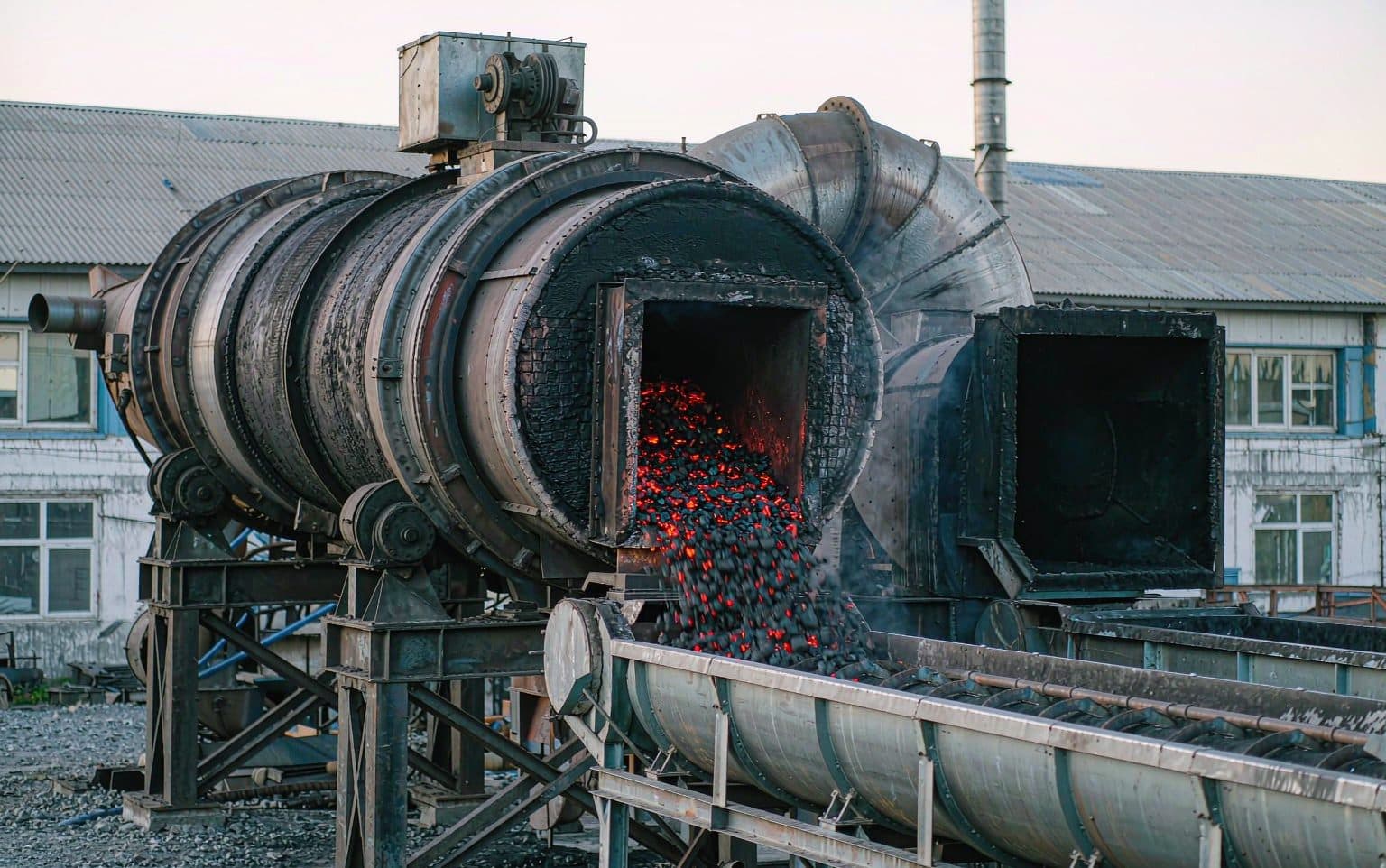
Key specifications
| Parameter | Value |
|---|---|
| Feed and drying section | Clay castable, Al₂O₃ 40–45%, 200 mm |
| Carbonization section | Wear-resistant high-alumina castable, Al₂O₃ 55–65%, 230 mm |
| Discharge section | Low-cement thermal-shock castable, 230 mm |
| Afterburner | High-alumina or mullite castable, 230–300 mm |
| Insulation | Lightweight castable or ceramic fibre board, 65–115 mm |
| Anchors | 310S stainless steel, V-shaped, 6 per m² |
| Expansion joints | 8–10 mm every 1.5 m |
| Carbonization section life | 3–4 years |
| Afterburner life | 2–3 years |
| Reline duration | 10–14 days including dry-out |
A carbonization furnace is not a low-temperature activation furnace
It is tempting to assume that a 450–550 °C zone is easier on refractories than an 1100 °C activation zone. In practice the carbonization lining often fails first, for three reasons: feedstock enters with 8–12% moisture, so steam carries tar and ash across the lining face; tar is viscous at low temperature and bonds with ash to build rings on the lining; and clearing those rings mechanically damages the working face directly.
Wear resistance and anti-ringing therefore outrank refractoriness in the carbonization section. A 70–80% alumina castable is not wrong technically, but it was formulated for alkali and steam at 1100 °C — spending that grade at 500 °C buys nothing and costs 20–30% more.
There is also a design problem the activation furnace does not have: ring removal. Making the ring-prone area demountable, or providing cleaning ports at the design stage, is far cheaper than dealing with it by sledgehammer later.
Four sections, four materials
| Section | Temperature | Dominant wear | Recommended material | Thickness | Typical life |
|---|---|---|---|---|---|
| Feed and drying | 200–400 °C | Moisture, light abrasion | Clay castable Al₂O₃ 40–45% | 200 mm | 4–5 years |
| Carbonization | 450–550 °C | Abrasion, tar ringing | Wear-resistant high-alumina castable Al₂O₃ 55–65% | 230 mm | 3–4 years |
| Discharge | 500–200 °C | Thermal shock, abrasion | Low-cement thermal-shock castable | 230 mm | 3–4 years |
| Afterburner | 850–1100 °C | Alkali, thermal shock, fly-ash erosion | High-alumina or mullite castable | 230–300 mm | 2–3 years |
The afterburner is the most underestimated wear part
The afterburner burns tar and combustibles in the off-gas at 850–1100 °C to meet emission limits. Its duty is far harsher than the carbonization section: high temperature, alkali-laden fly ash, and repeated thermal shock from starts and stops. Most projects see 2–3 years from the afterburner lining, one to two years less than the carbonization section.
Failure follows a pattern: cracking at the anchor roots, then small pieces spalling, then large areas detaching. The cause is rarely overtemperature — it is a fast ramp or an emergency stop. One abrupt cycle is enough to crack the surface layer of a castable.
The lining thickness should be sized for peak temperature rather than normal operating temperature, and the afterburner needs its own expansion joints. Treating it as part of the carbonization temperature zone is the most common lining error on these furnaces.
Rings, ring removal and lining life
- Ringing is a process problem, not a lining problem: high feed moisture, low carbonization temperature and poor gas flow all deposit tar on the lining.
- Mechanical ring removal takes the working face off with it; where controlled cooling will release the ring, avoid the hammer.
- Provide cleaning ports or demountable panels at the design stage for ring-prone areas.
- Log ring position at every shutdown: the same location twice in a row means check feed moisture and the temperature curve, not buy a more expensive brick.
Inspection schedule
- One shutdown per year: measure residual thickness in the carbonization section and afterburner, with attention to anchor roots.
- Below 50% of original thickness, or a spall larger than 0.2 m², patch locally.
- Replace the afterburner lining every 2–3 years and the carbonization section every 3–4.
- A reline takes 10–14 days including dry-out: 2 days cooling, 2 days demolition, 3–4 days casting and curing, 3 days dry-out.
- Log shell temperatures for the first week after restart; 30 °C above baseline is a stop-and-inspect signal.
Do not specify one recipe for the whole line
On a complete line, the carbonization and activation linings are often bought as one package and supplied in one grade. That is a mistake: the carbonization section needs wear resistance and anti-ringing, the activation section needs alkali and steam oxidation resistance, and the afterburner needs thermal shock resistance. Specifying one material to the highest temperature leaves the low-temperature zones over-specified and the hot zones under-specified. A section-by-section bill of materials is the cheapest maintenance decision on the line.
Questions buyers ask before ordering
Straight answers with numbers. If yours is missing, send it over.
Can a carbonization furnace be brick-lined?
Why does the afterburner fail faster than the carbonization section?
Does lining spall affect product quality?
How should rings be removed without damaging the lining?
How long does a carbonization furnace reline take?
Send the raw material, target tonnage and finished spec. You get a configuration, a utility schedule and a budget range — not a brochure.