Line equipment — crushing, screening, drying, cooling, conveying and packing
Five stages sized off the main kiln. The kiln sets the iodine value; these five decide whether the plant actually reaches its rated tonnage.
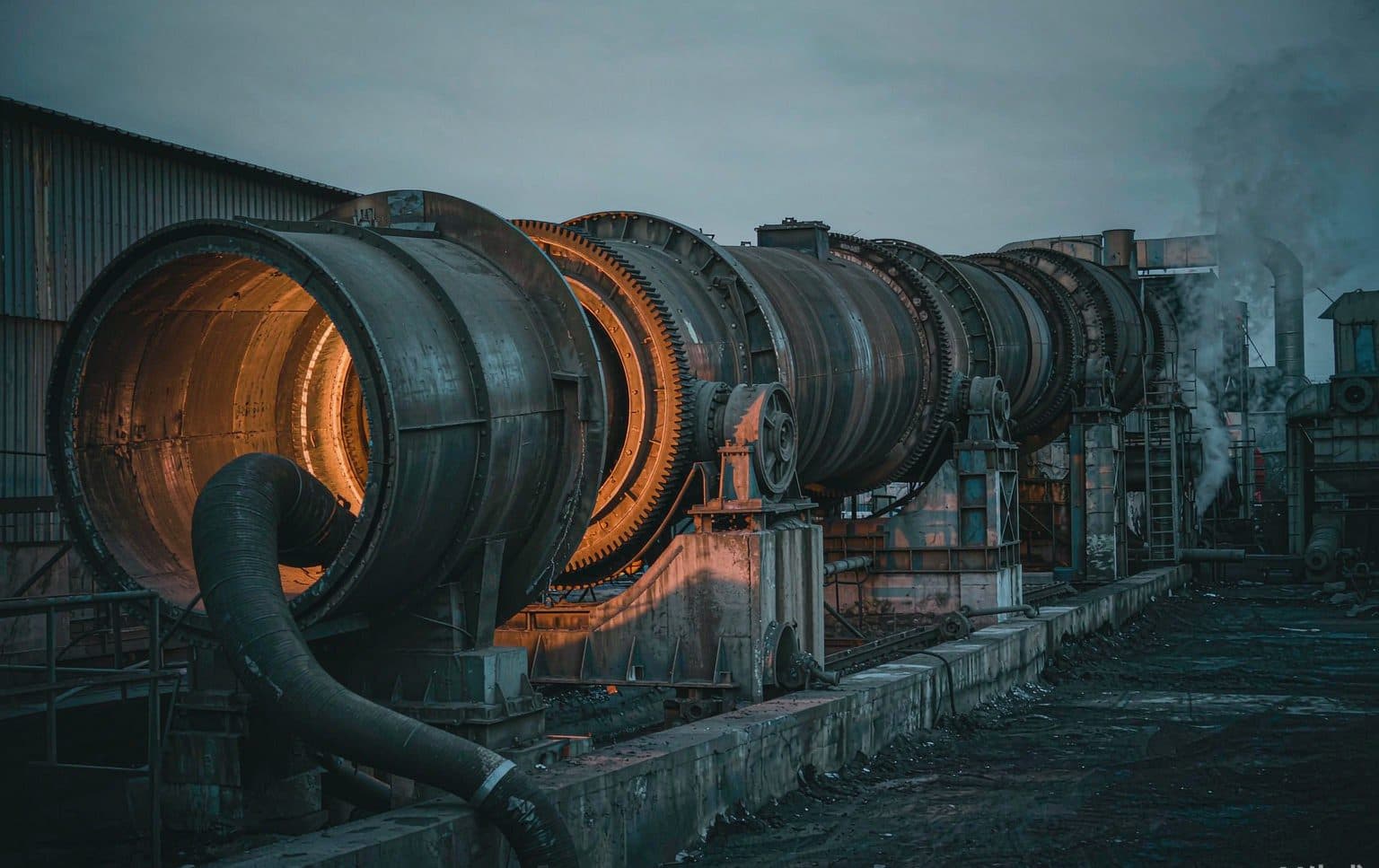
Key specifications
| Stage | Equipment and size |
|---|---|
| Main line | 1.0 t/h finished carbon (coconut shell, 1,000–1,050 mg/g) |
| Crushing | Hammer or roll crusher, 6–8 t/h of raw shell |
| Screening | Two-deck trommel, 3–12 mm product, 8–10 t/h |
| Drying | Rotary dryer Φ1.5 × 12 m, 6–7 t/h, 18% → 8% moisture |
| Cooling | Rotary cooler Φ1.2 × 8 m, 1.2 t/h, discharge ≤ 60 °C |
| Conveying | Drag chain + bucket elevator, ≤ 200 °C, water-jacketed on hot sections |
| Packing | 25 kg semi-automatic, 2–3 bags/min, ±0.5% accuracy |
| Dust extraction | 4,000–6,000 m³/h at crushing and screening; 2,000–4,000 m³/h at packing |
| Installed power | 55–75 kW for the auxiliary set |
| Delivery | 60–90 days, shipped to site with the main kiln on one layout |
The kiln sets iodine value; the auxiliaries set output
Nobody gets this wrong about the kiln itself. But when a plant rated at 2 t/h settles at 1.6 t/h, the cause is almost always at one of the two ends: feed that was never screened properly going in, or carbon that never cooled down coming out. Neither appears on the main equipment quotation.
That is why we size the five stages on the same layout drawing as the kiln instead of leaving the customer to source them separately. Screening capacity, dryer evaporation, cooling area and packing rate are all back-calculated from the main line's hourly output, with 20–50% headroom — not caution, but because feed moisture, particle size and season will consume part of it.
Sized for 1, 2 and 3 t/h lines
| Stage | 1 t/h line | 2 t/h line | 3 t/h line |
|---|---|---|---|
| Crushing (raw shell) | 6–8 t/h | 11–13 t/h | 16–18 t/h |
| Screening | 8–10 t/h, two decks | 14–17 t/h, two decks | 20–24 t/h, three decks |
| Drying | Φ1.5 × 12 m | Φ1.8 × 14 m | Φ2.2 × 16 m |
| Cooling | Φ1.2 × 8 m | Φ1.5 × 10 m | Φ1.8 × 12 m |
| Packing | 2–3 bags/min, semi-auto | 3–4 bags/min | 4–6 bags/min, twin station |
| Auxiliary installed power | 55–75 kW | 95–120 kW | 140–180 kW |
What each stage is for
Crushing and screening
Shell is crushed to the target size and split on a trommel or vibrating screen into 3–12 mm kiln feed and sub-3 mm fines. This is the stage most often trimmed: an undersized screen, or none at all, compacts a shaft furnace bed until the gas short-circuits, or blows fines straight into the rotary kiln's off-gas. Fines have to leave the circuit here; downstream they are pure loss.
Drying
A rotary dryer takes shell from 12–18% moisture down to below 8%. Heat comes from the waste-heat boiler or afterburner flue gas at 300–400 °C, so no extra fuel is burned. Skipping this stage costs 10–15% of carbonization capacity, because the kiln's heat goes into boiling water instead of pyrolysis.
Cooling
Hot carbon leaving the kiln must reach below 60 °C in a water jacket or rotary cooler before it touches a belt. Above 120 °C it oxidises on the conveyor and the last 20–30 mg/g of iodine value disappears. Wet-season feed makes it worse. This is the stage most often sized from the paper rating rather than the real duty.
Conveying
Drag chains, bucket elevators and belts selected per temperature and abrasiveness: water-jacketed or heat-resistant on hot sections, standard belt after cooling. Enclosure and dust extraction go in together — activated carbon dust is both abrasive and conductive, and it finds motor terminals and switchgear.
Packing and dust extraction
25 kg bags, 500 kg bulk bags or loose. Weighing at ±0.5%, with de-aeration and compaction for bulk bags. Dust extraction at the packing head is not cosmetic: it decides whether the plant passes an environmental inspection, and whether anyone will work a full shift there.
The two places where saving money costs more
Screening first. Screens are cheap, so they are the first line item cut. But feed with more than 15% below 3 mm will not reach rated iodine value in a shaft furnace, and in a rotary kiln it shows up as dust loading and rapid fouling in the waste-heat boiler. Two decks and quick-change mesh cost far less at build stage than a second screen later.
Cooling second. A cooler sized on nominal conditions runs out of capacity in the wet season. On the 3 t/h palm kernel shell plant in Kalimantan the cooler was designed for the same 80 °C discharge, but it was sized on nominal conditions with no margin, and in the wet season it delivered carbon to screening at 90–110 °C — above the point where fines begin to oxidise. Lengthening the cooling section by four metres brought discharge to 55–65 °C with no extra water and stabilised the iodine value. That change cost far less than a year of lost iodine value.
Auxiliary stages in three delivered projects
| Project | Auxiliary scope | What happened on site |
|---|---|---|
| 2 t/h coconut shell line, Sumatra | 60 t homogenising silo with blending screw; discharge cooler sized at 2 t/h, 80 °C outlet | Char from four suppliers ranged 780–1,020 mg/g iodine potential and was blended before the kiln; in the wet season discharge ran 110–120 °C and cooling became the bottleneck |
| 3 t/h palm kernel shell plant, Kalimantan | Cooling section lengthened by 4 m; waste-heat boiler tied into the dryer | Discharge held at 55–65 °C; waste heat covered 46% of plant steam, net fuel 38% below estimate |
| 1 t/h hazelnut shell line, Türkiye | Crushing and screening switched by seasonal batch; 25 kg semi-automatic packing | 14.8% overall yield, 590 t in the first year, run in 6–8 week campaigns |
Supply and delivery
- Any single stage can be supplied on its own or as part of a complete line — quoted separately either way.
- One layout drawing with the main kiln: interface elevations, chute angles and dust pick-up points defined once.
- Electrical and control in the same PLC cabinet, so no interlock gap between kiln supplier and equipment supplier.
- Commissioning once, with the performance test run as a 72-hour continuous line test.
- Wear parts (screen mesh, hammers, drag flights, belts) shipped with the machine, with replacement intervals stated.
Size from one number only: the line's hourly output
Do not size from a supplier's nominal throughput. Two screens both rated 10 t/h will differ by 30% in effective capacity between coconut shell and palm kernel shell. Give bulk density, moisture and size distribution, and let the equipment be back-calculated on effective capacity. Withhold one of those numbers and the margin becomes a guess — usually in the wrong direction.
Questions buyers ask before ordering
Straight answers with numbers. If yours is missing, send it over.
Can I buy just one stage?
Hammer crusher or roll crusher?
How long does the cooler need to be?
How is dust extraction capacity set?
What changes on a powder carbon line?
Send the raw material, target tonnage and finished spec. You get a configuration, a utility schedule and a budget range — not a brochure.