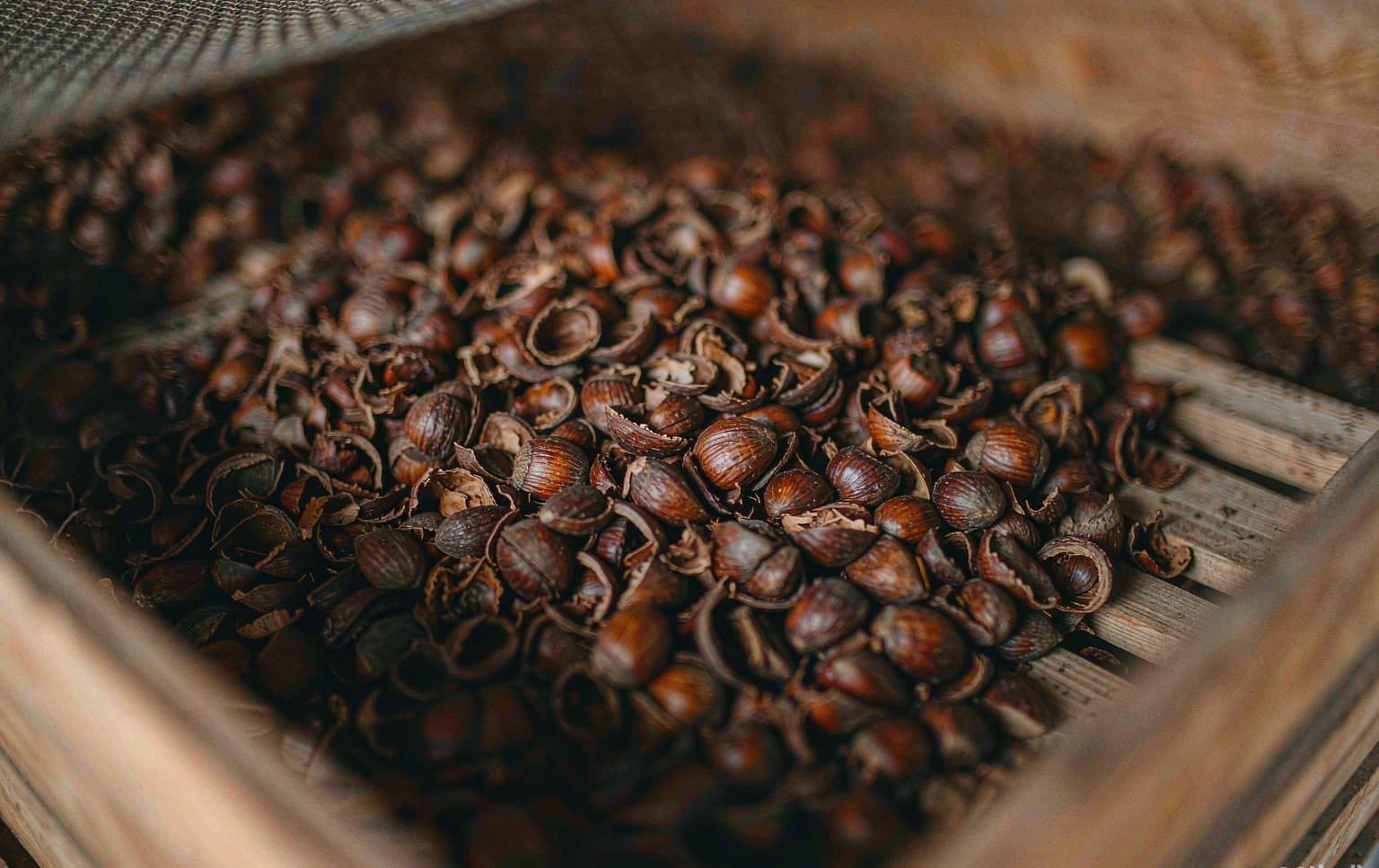
Hazelnut shell activated carbon line — 0.5 to 3 t/h, 900–1,050 mg/g
Lower yield than coconut, but a real feedstock where hazelnut processing already concentrates the shell. Here is the mass balance before you commit to a kiln size.
Key specifications
| Parameter | Value |
|---|---|
| Shell bulk density | 450–550 kg/m³ |
| Feed moisture | ≤ 12% |
| Feed ash | 2–4% |
| Carbonization yield | 24–28% |
| Activation yield | 58–62% |
| Overall yield | 14–17% |
| Finished iodine value | 900–1,050 mg/g |
| Hardness | 88–94% |
| Ash content | 3–5% |
| Bulk density (finished) | 380–450 kg/m³ |
Worked example — 3,000 t/year of hazelnut shell
| Item | Value | Basis |
|---|---|---|
| Shell available | 3,000 t/year | 10 t/day over 300 days |
| Char produced | 780 t/year | 26% carbonization yield |
| Carbon produced | 470 t/year | 60% activation yield |
| Daily carbon output | 1.57 t/day | 300 days |
| Hourly output, 1 shift | 0.20 t/h | 8 hours |
| Recommended furnace | HL-800 (0.5 t/h) | Run 3–4 h/day, or batch weekly |
| Alternative | Share a 1 t/h line | Aggregate with a second processor |
What changes compared with coconut shell
Hazelnut shell is thinner-walled and less dense than coconut, so it carbonizes faster and produces a char with lower bulk density. Two consequences follow. The kiln's volumetric throughput becomes the limit before its mass throughput does — you cannot simply load more char to compensate. And the finished carbon is lighter, around 380–450 kg/m³, which changes packing, freight and the volume your silo needs.
Ash is the second difference. Hazelnut shell typically carries 2–4% ash, and the finished carbon lands at 3–5%, which is acceptable for wastewater but marginal for potable water. If your market needs ash below 3%, add a post-activation acid wash; it is a small circuit and we include it in the quotation when the end use requires it.
The third difference is seasonal supply. Shell arrives over a few months and must be stored dry for the rest of the year. Plan storage for the full annual volume, or accept buying charcoal for part of the year — both are common, and both change the line configuration.
Where hazelnut carbon sells
- Wastewater and landfill leachate treatment — the largest volume use, tolerant of 3–5% ash.
- Decolourization in food processing, where lower hardness is acceptable in powder form.
- Soil and compost amendment, usually as a lower-grade product.
- Gold recovery — possible, but coconut shell carbon dominates because of its hardness.
A sizing mistake we see every year
A processor with 3,000 t/year of shell buys a 1 t/h furnace because it looks like the standard size, then runs it 1.5 hours a day. Capital sits idle, the lining never reaches a stable thermal regime, and fuel per tonne is double. For seasonal shell supply, a 0.5 t/h unit running scheduled campaigns is almost always the better financial answer.
Questions buyers ask before ordering
Straight answers with numbers. If yours is missing, send it over.
How much hazelnut shell is needed per tonne of activated carbon?
Can the same furnace run coconut and hazelnut shell?
Is the ash content a problem?
What does a 0.5 t/h hazelnut line cost?
Send the raw material, target tonnage and finished spec. You get a configuration, a utility schedule and a budget range — not a brochure.