Shaft (Slep) furnace — 0.5 to 2 t/h of granular carbon from shell char
A gravity-fed vertical furnace with three independently fired zones. The charge never tumbles, so a 12 mm coconut granule leaves the discharge still 12 mm — and typically 40–60 mg/g higher in iodine value than the same char run through a rotary kiln.
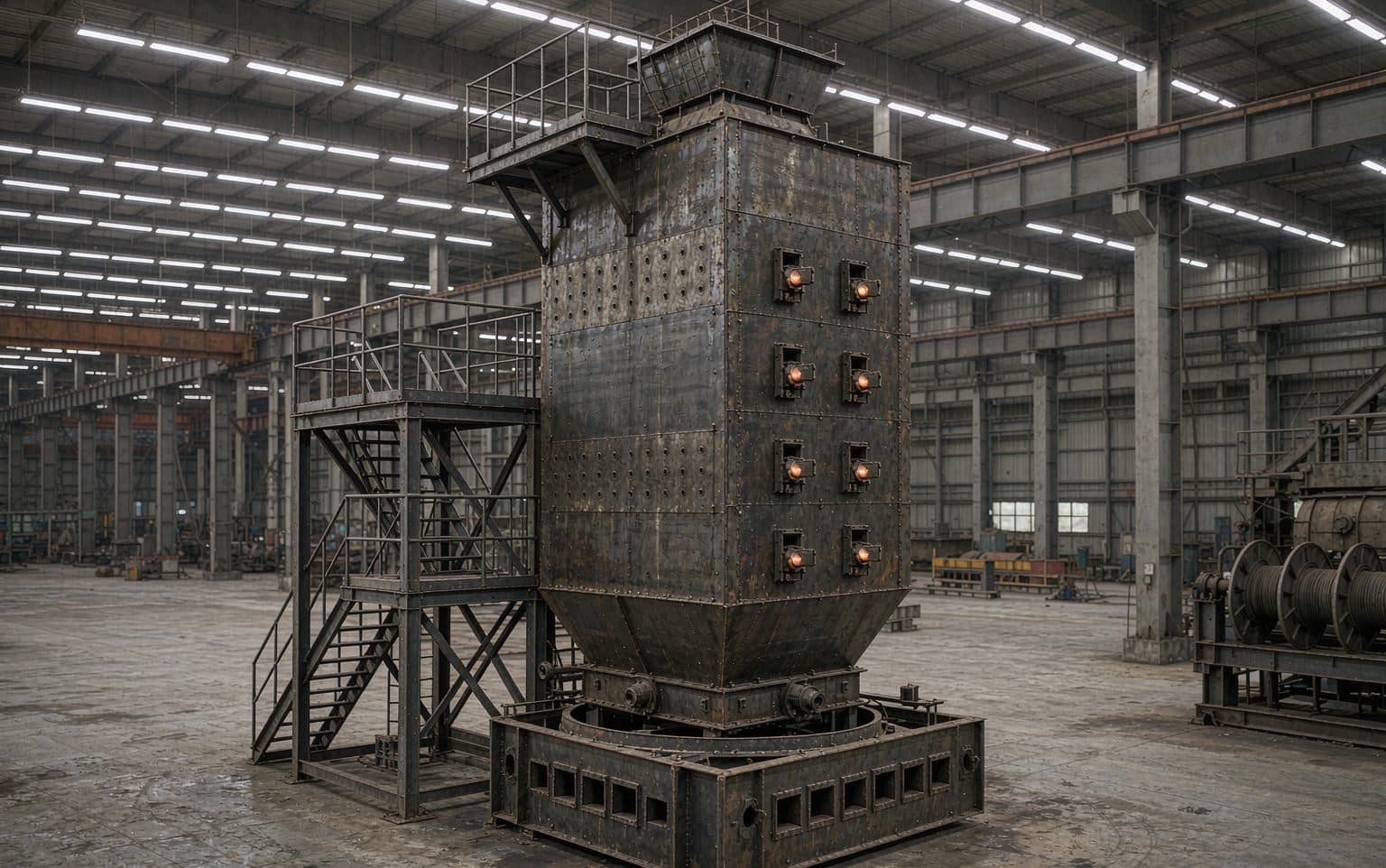
Key specifications
| Parameter | Value |
|---|---|
| Finished capacity | 1.0 t/h · 24 t/day |
| Char feed rate | 1.65–1.75 t/h, screened 3–12 mm |
| Furnace height | 11.5 m (preheat 3 / activation 5 / cooling 3.5) |
| Reaction cross-section | 1.4 × 1.1 m |
| Activation temperature | 900–1,100 °C, 3 zones, independent burners |
| Residence time | 4–8 h, set by discharge rate |
| Steam consumption | 1.8 t/h at 0.6 MPa |
| Heat supply | 3–4 side burners per zone + reaction gas |
| Fuel | Natural gas / LPG / diesel / biomass gas |
| Refractory | High-alumina brick working layer + castable + insulation |
| Shell material | Q235B steel casing with brick-lined core |
| Installed power | 45 kW |
| Discharge temperature | ≤ 90 °C after water-jacketed cooling zone |
| Instrumentation | PLC + per-zone thermocouples + discharge weight control |
| Design life | Lining 5–8 years, steel casing 15+ years |
How the charge moves
Top feed and preheat
Screened char is charged through a double bell valve that keeps air out. The top 3 m is a preheat zone: rising hot gas dries the charge and brings it to 400–600 °C before it reaches the reaction section.
Activation zone
Superheated steam enters through side ports in the middle 5 m. The endothermic reaction C + H₂O → CO + H₂ runs as the gas rises against the descending bed. Side burners hold each of the three zones at its own setpoint, which is what makes a shaft furnace more uniform than a rotary kiln.
Cooling zone
The bottom 3.5 m is a water-jacketed cooling section. Carbon leaves below 90 °C, so it does not burn off surface area on contact with air.
Discharge control
A rotary discharge table runs on a weight-per-revolution basis. Residence time is set here — not by kiln speed and slope as on a rotary unit — which is why the operator has one number to hold instead of two.
Why shell char often goes to a shaft furnace
Shell char is dense and hard. That is exactly the property a shaft furnace rewards and a rotary kiln wastes. In a rotary kiln the bed tumbles roughly 25,000 times over a 60-minute pass; a proportion of every granule abrades into fines that leave with the off-gas. In a shaft furnace the bed is static, so shape and size survive the process.
The second advantage is temperature uniformity. A rotary kiln has an axial profile — the first third is cooler than the last. A shaft furnace holds each zone at its setpoint, so every granule sees nearly the same history regardless of when it entered. Iodine value spread across a shift is typically ±20 mg/g against ±40 mg/g for a rotary kiln at the same tonnage.
The trade is investment and flexibility. A shaft furnace costs 20–35% more than a rotary kiln of the same capacity, needs screened feed within a narrow size band, and takes 72 hours to heat up or cool down. If your feed varies in size or you want to switch between granular and powdered product, the rotary kiln is the better machine.
Shaft furnace against rotary kiln, same 1 t/h duty
| Item | Shaft (Slep) | Rotary kiln |
|---|---|---|
| Residence time | 4–8 h | 45–90 min |
| Iodine value reachable | 1,000–1,150 mg/g | 900–1,100 mg/g |
| Iodine spread across shift | ±20 mg/g | ±40 mg/g |
| Attrition to fines | 2–4% | 8–12% |
| Feed size window | 3–12 mm, screened | 2–12 mm, wider tolerance |
| Steam per kg char | 1.5–2.2 kg | 1.2–2.0 kg |
| Heat-up / cool-down | 72 h | 8–12 h |
| Relative capex at 1 t/h | 1.20–1.35× | 1.00× |
| Lining life | 5–8 years | 3–5 years |
| Typical fit | Granular and cylindrical carbon | Mixed sizes, powder, frequent product changes |
Scope of supply
- Brick-lined vertical furnace with three independently fired zones and a water-jacketed cooling section.
- Top feed hopper, double bell valve and vibrating feeder with screen.
- Steam distribution ports, superheater and feed-water pump set (boiler optional).
- Side burner sets, fuel train and combustion air fan per zone.
- Rotary discharge table with weight-based residence control.
- PLC cabinet with per-zone temperature control, trend recording and alarm log.
- Structural steel, platforms, ladders and foundation drawings.
- O&M manual, start-up curve and two-year spare parts list.
The one thing that kills a shaft furnace
Feed that is out of spec. A shaft furnace relies on a permeable bed: if more than about 15% of the charge is below 3 mm, the bed packs, gas channels, and the furnace either chokes or over-fires one side. If your char arrives unscreened, budget for a screening station before you budget for the furnace — otherwise the furnace will never reach its rated iodine value.
Questions buyers ask before ordering
Straight answers with numbers. If yours is missing, send it over.
Why would I choose a shaft furnace over a rotary kiln for coconut shell?
Can a shaft furnace make powdered activated carbon?
How long does start-up and shut-down take?
What does a shaft furnace cost compared with a rotary kiln?
How often does the lining need replacing?
Send the raw material, target tonnage and finished spec. You get a configuration, a utility schedule and a budget range — not a brochure.