Which activation furnace do I need? Rotary, shaft, fluidized bed or multiple hearth
Four furnace types do the same chemical job and produce four different products. The choice is decided by three inputs — raw material, target product form, and tonnage — not by which one is technically superior.
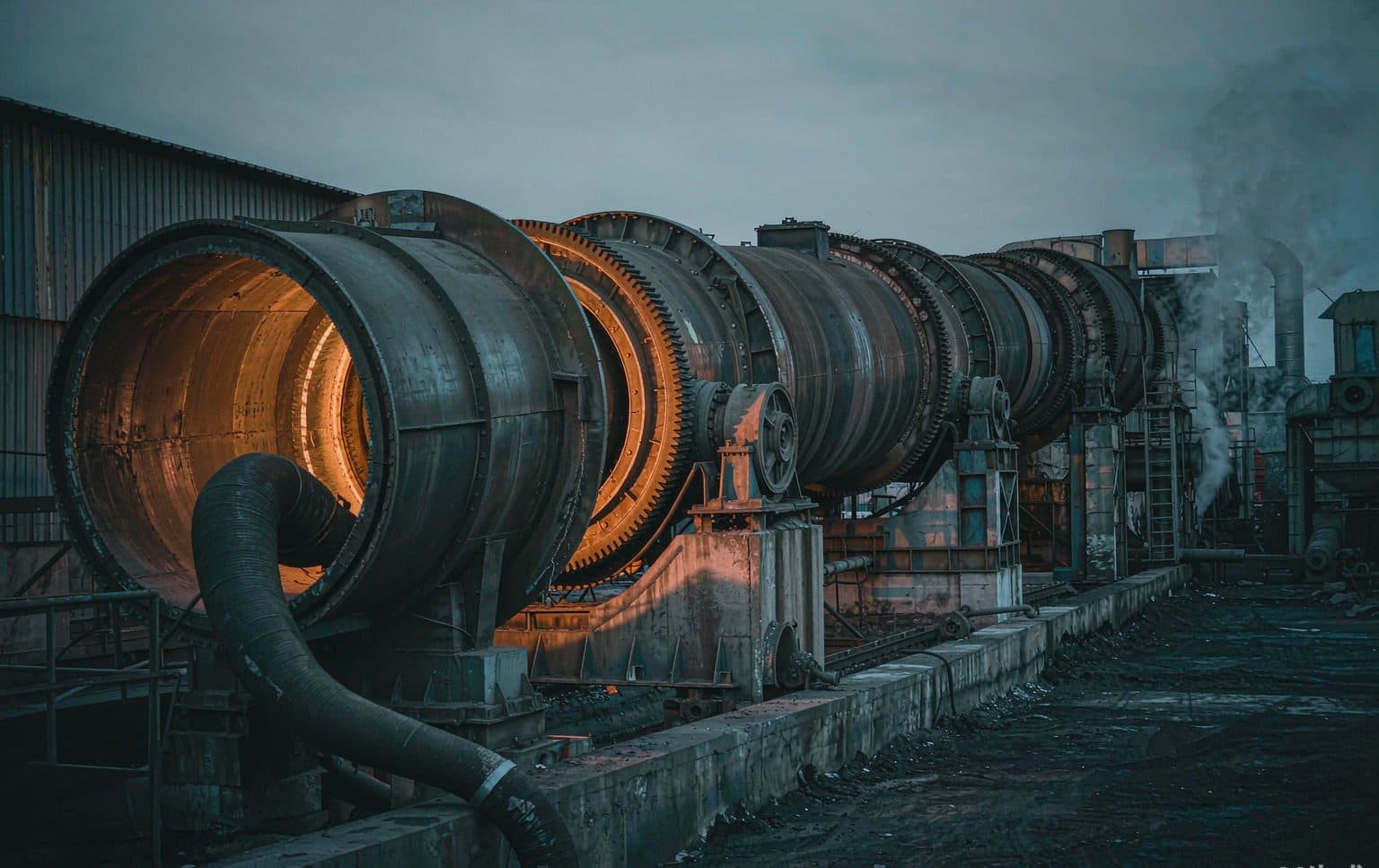
Start with the product, not the furnace
Almost every wrong furnace decision starts the same way: the buyer specifies a furnace before specifying the product. A furnace is only a way of holding a material at temperature in a particular gas for a particular time. Change the product form and the correct furnace changes with it.
So answer three questions in this order. First, what physical form does your customer buy — granule, cylinder, or powder? Second, what iodine value and what spread across a shipment will they accept? Third, what tonnage must you hold, and does your raw material arrive in a consistent size? Everything else — price, supplier, country of origin — is downstream of those three.
The four types, side by side
| Rotary kiln | Shaft (Slep) | Fluidized bed | Multiple hearth | |
|---|---|---|---|---|
| Feed size | 2–12 mm, wide tolerance | 3–12 mm, screened | Fine and narrow, usually < 1 mm | Granular or powder |
| Residence time | 45–90 min | 4–8 h | 10–30 min | 2–4 h |
| Temperature uniformity | Fair — axial gradient | Good — per-zone control | Excellent — near isothermal | Fair |
| Attrition | 8–12% to fines | 2–4% | High — 15–25% | 5–10% |
| Iodine value achievable | 900–1,100 mg/g | 1,000–1,150 mg/g | 1,000–1,200 mg/g | 950–1,150 mg/g |
| Product form | Granular, cylindrical, powder | Granular, cylindrical | Powder only | Granular, powder, specialty |
| Heat-up time | 8–12 h | 72 h | 4–6 h | 12–24 h |
| Relative capex at 1 t/h | 1.00× | 1.20–1.35× | 1.15–1.40× | 1.50–1.80× |
| Maintenance burden | Low | Low | High — distributor plates, cyclones | High — rakes, hearths |
| Typical use | Shell char, mixed feed, general purpose | Coconut and apricot shell, premium granular | Powdered carbon, resin-based spherical carbon | Regeneration, catalyst support, specialty |
Match the raw material
| Raw material | Product form | Correct furnace | Wrong choice | Why |
|---|---|---|---|---|
| Coconut shell | Granular / cylindrical | Shaft furnace, or rotary kiln | Fluidized bed | Hard, dense shell survives a static bed; fluidization grinds it to fines |
| Palm kernel shell | Granular | Rotary kiln | Fluidized bed | Denser than coconut, needs longer residence; rotary tolerates it |
| Hazelnut shell | Granular / powder | Rotary kiln | Shaft furnace | Thinner shell, wider size spread — a shaft bed will channel |
| Wood, sawdust | Powder (PAC) | Fluidized bed | Rotary kiln | Light and fine; a rotary kiln dusts it out the stack |
| Coal-based | Powder or granular | Rotary kiln or fluidized bed | — | Depends on target: granular goes rotary, PAC goes fluidized |
| Spent carbon (regeneration) | As received | Multiple hearth or rotary | Fluidized bed | Regeneration needs gentle handling to preserve the existing pore structure |
| Resin-based spherical | Spherical, uniform | Fluidized bed | Rotary kiln | Only fluidization gives the uniformity these buyers test for |
Where the fluidized bed actually wins — and where it does not
A fluidized bed is the most efficient of the four in heat and mass transfer. Because the bed is nearly isothermal and the gas-solid contact is intense, activation takes 10–30 minutes instead of 60–480. That is a real advantage: smaller vessel, faster response, tighter control.
It also has the highest attrition of the four. Particles collide with each other and with the reactor wall continuously, so 15–25% of the charge can leave as fines, and the product that survives is often more brittle than what a static bed produces. That is why fluidized beds are used for powder — where the product is ground anyway — and for uniform spherical material, and almost never for premium granular coconut carbon.
If your product is granular, a fluidized bed is not a faster version of the right answer; it is the wrong answer. If your product is PAC, it is usually the correct choice, and a rotary kiln is the compromise.
A four-question decision path
- Is your product powder? If yes → fluidized bed (or rotary kiln if feed size varies). If no, continue.
- Is your feed hard shell char, screened to a narrow band, and do you need premium iodine value? If yes → shaft furnace.
- Is your feed mixed in size, or will you change product form between campaigns? If yes → rotary kiln.
- Is your application regeneration or a specialty grade where iodine spread must be ±20 mg/g? If yes → multiple hearth, and budget for the maintenance.
What gets designed here, and what you will be told not to build
We build rotary kilns and shaft furnaces, and quote complete lines around either. We do not build fluidized beds or multiple-hearth furnaces. If your product is powder or your application is regeneration, we will say so at the first call rather than sell you a rotary kiln that cannot hit your specification — a furnace that disappoints is a worse outcome for both of us than a lost order.
Questions buyers ask before ordering
Straight answers with numbers. If yours is missing, send it over.
Rotary kiln or shaft furnace for coconut shell — which is better?
Is a fluidized bed suitable for coconut shell carbon?
How do I know whether I need one stage or two?
What is the smallest sensible capacity?
Does furnace choice change the raw material consumption?
Can I visit a running line before deciding?
Send the raw material, target tonnage and finished spec. You get a configuration, a utility schedule and a budget range — not a brochure.