Rotary activation furnace — 0.5 to 3 t/h at 850–950 °C
A three-zone refractory shell, variable-speed drive and indirect hot-gas jacket that hold iodine value within ±30 mg/g across a full shift, on shell char from 2 mm to 12 mm.
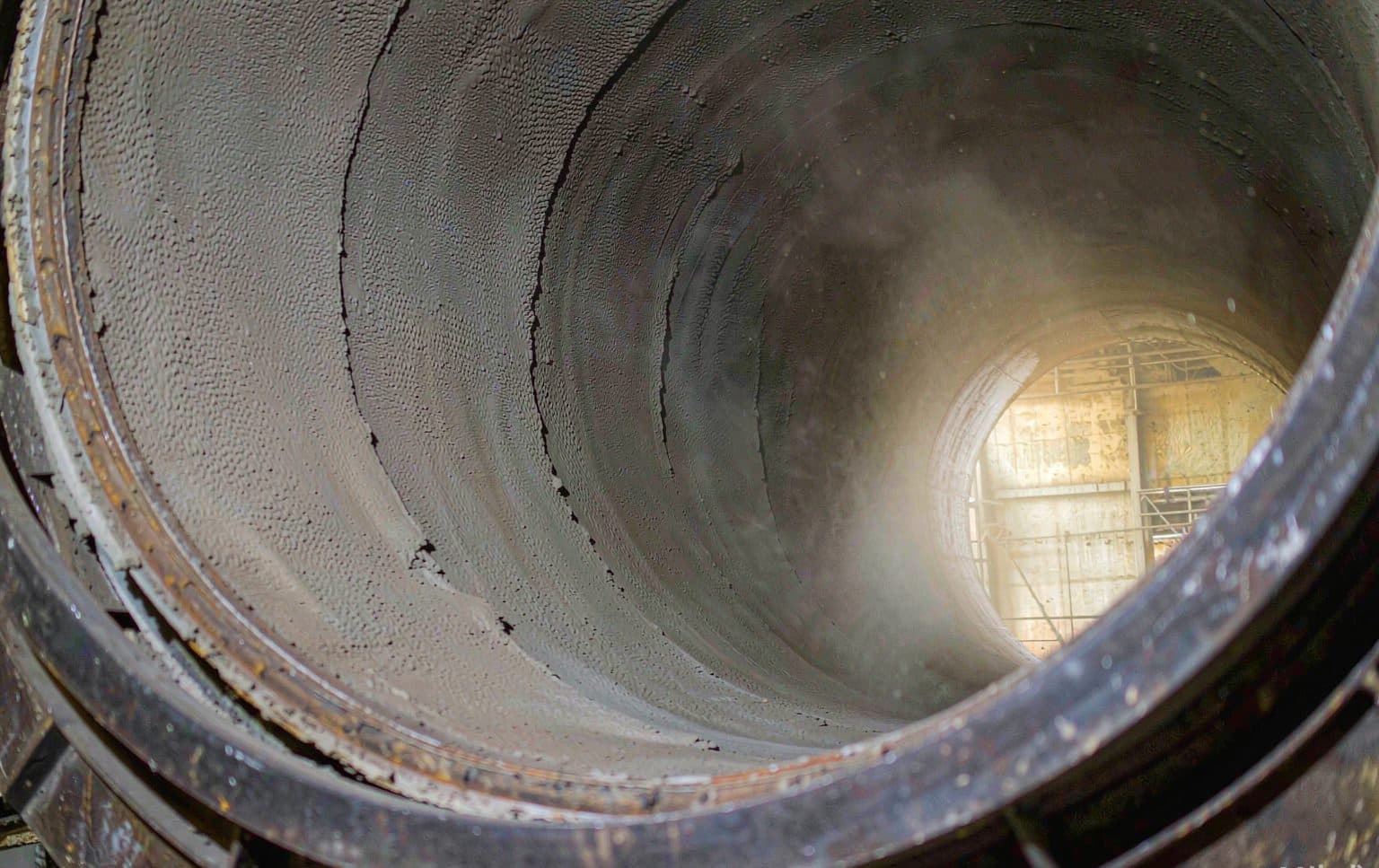
Key specifications
| Parameter | Value |
|---|---|
| Finished capacity | 1.0 t/h · 24 t/day |
| Char feed rate | 1.65–1.75 t/h |
| Shell diameter × length | 1.2 m × 18 m |
| Rotation speed | 0.3–1.2 rpm, VFD |
| Installation slope | 2.5° |
| Activation temperature | 850–950 °C, 3 zones |
| Residence time | 45–90 min |
| Steam consumption | 1.8 t/h at 0.8 MPa |
| Heat consumption | 2,800–3,500 kJ/kg carbon |
| Fuel | Natural gas / LPG / diesel / biomass gas |
| Refractory | High-alumina castable + 65 mm insulation |
| Shell material | Q345R plate, 16 mm, stress-relieved |
| Installed power | 75 kW |
| Discharge temperature | ≤ 80 °C after water jacket |
| Instrumentation | PLC + 3-zone thermocouple + O₂ trim |
| Design life | Lining 3–5 years, shell 12+ years |
What happens inside the shell
Zone 1 — feed and dry (200–400 °C)
Wet char enters through a double flap valve that keeps air out. Residual moisture flashes off; the zone is deliberately long so water leaves before the material reaches activation temperature.
Zone 2 — heat to reaction temperature (400–850 °C)
Indirect hot gas from the combustion chamber passes through the jacket. Volatiles still bound in the char are driven off and burned in the chamber, which is why fuel consumption drops once the line is stable.
Zone 3 — steam activation (850–950 °C)
Superheated steam enters through a distribution pipe running the length of the kiln. The endothermic reaction C + H₂O → CO + H₂ opens pores. Residence time and steam ratio here decide the iodine value.
Discharge and cool
Carbon drops into a water-jacketed screw cooler and reaches below 80 °C before contact with air — above that, hot carbon burns off the surface area you just paid for.
Gas handling
Off-gas passes a cyclone, a waste-heat boiler if fitted, a scrubber and an ID fan. Particulate and CO are controlled here, not at the stack.
Where iodine value is actually lost
Iodine value is set in the last 8 metres of the kiln, and most of the losses we are called in to fix come from four mechanical causes rather than process chemistry.
First, a lining that has spalled in zone 3 creates a cold patch; carbon passing that patch is under-activated and blends into the good product. Second, a steam pipe with blocked or oversized holes delivers uneven steam along the length — the kiln average looks correct while half the cross-section is starved. Third, feed rate creep: operators push tonnage up 10% to hit a shipment, residence time falls, and iodine value drops 40 mg/g before anyone checks. Fourth, discharge temperature above 100 °C, which burns off surface area after the fact.
Our control philosophy addresses each one directly: three independent thermocouples with trend alarms, a removable steam distribution pipe with a documented hole pattern, feed rate interlocked to kiln speed rather than set independently, and a discharge cooler sized with 30% margin.
Model range
| Model | Capacity | Char feed | Steam | Power | Footprint |
|---|---|---|---|---|---|
| HL-800 | 0.5 t/h · 12 t/d | 0.85 t/h | 1.0 t/h | 55 kW | 18 × 8 m |
| HL-1200 | 1.0 t/h · 24 t/d | 1.70 t/h | 1.8 t/h | 75 kW | 24 × 10 m |
| HL-1500 | 1.5 t/h · 36 t/d | 2.50 t/h | 2.6 t/h | 95 kW | 26 × 10 m |
| HL-1800 | 2.0 t/h · 48 t/d | 3.35 t/h | 3.2 t/h | 110 kW | 28 × 11 m |
| HL-2200 | 3.0 t/h · 72 t/d | 5.00 t/h | 4.8 t/h | 160 kW | 34 × 12 m |
Scope of supply
- Rotary shell with refractory lining, cast and cured on a logged curve before dispatch.
- Combustion chamber, burner and fuel train for gas, LPG, diesel or biomass gas.
- Steam distribution pipe, superheater and feed-water pump set (steam boiler optional).
- Variable-speed drive with auxiliary motor for maintenance rotation.
- Water-jacketed discharge cooler and screw conveyor.
- PLC cabinet with three-zone temperature control, trend recording and alarm log.
- Cyclone, scrubber, ID fan and ducting to the stack flange.
- Foundation drawings, utility schedule, O&M manual and spare parts list for two years.
A note on quoted capacity
Ask whether a quoted tonnage refers to finished carbon or to char feed. The two differ by roughly 40%, and a quotation that does not state the basis cannot be compared with one that does. Ours are always finished carbon, dry basis, at the stated iodine value.
Questions buyers ask before ordering
Straight answers with numbers. If yours is missing, send it over.
What iodine value can a rotary furnace reach?
How much steam does the furnace need?
Gas, diesel or biomass — which fuel should I choose?
How is the lining maintained?
Can the furnace run at partial load?
Send the raw material, target tonnage and finished spec. You get a configuration, a utility schedule and a budget range — not a brochure.