1 t/h activated carbon line — 24 t/day, layout, utilities and budget
The most common size we build, and the one where sizing errors cost the most. Here is the full utility schedule, footprint and staffing before you ask for a price.
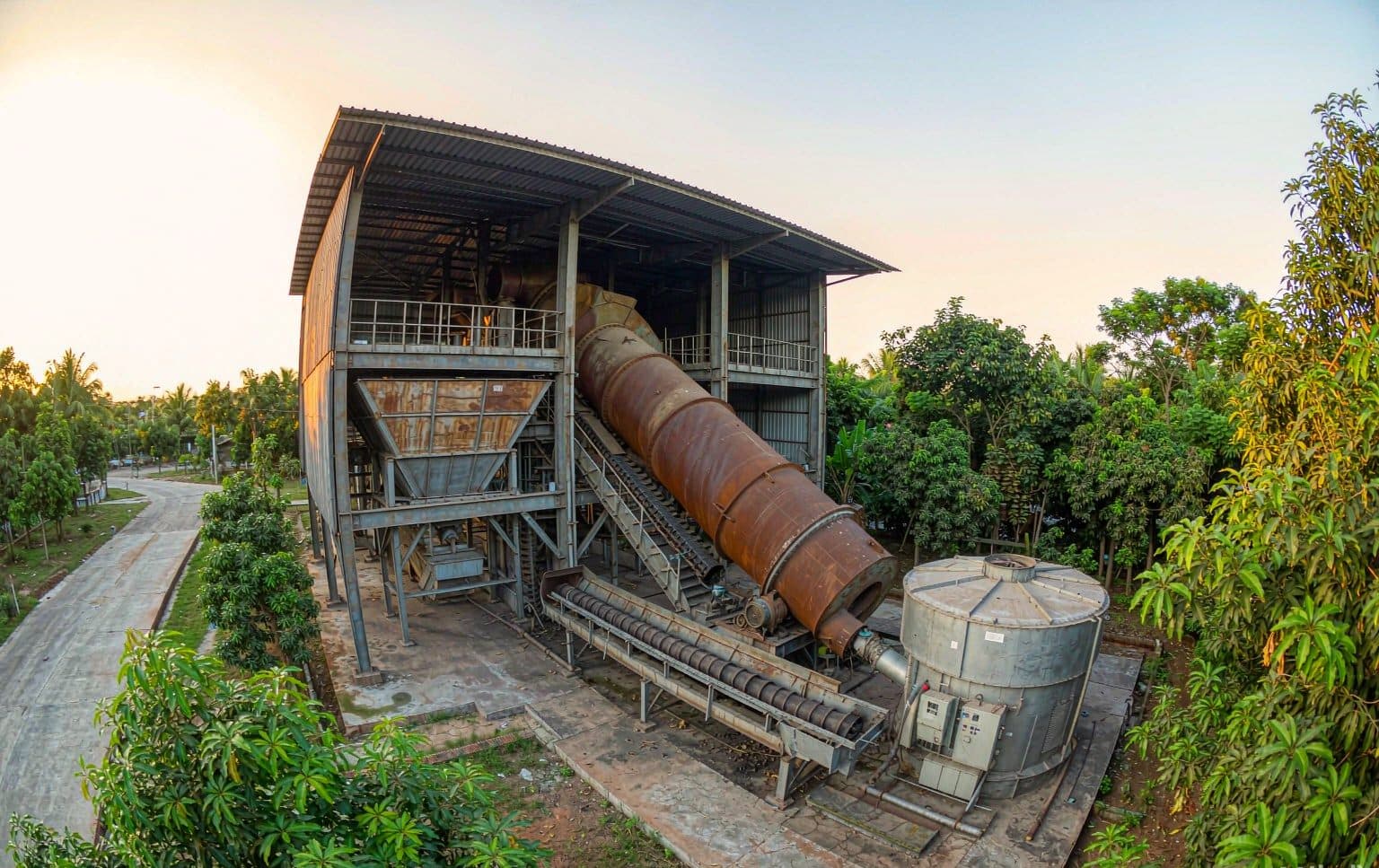
Key specifications
| Item | Requirement |
|---|---|
| Finished output | 1.0 t/h · 24 t/day |
| Char feed | 1.65–1.75 t/h |
| Steam | 1.8 t/h at 0.8 MPa, saturated or superheated |
| Fuel | Natural gas 120–160 Nm³/h, or diesel 100–130 kg/h |
| Installed power | 75 kW (about 55 kW average draw) |
| Cooling water | 12 m³/h, 32 °C supply |
| Compressed air | 1.2 m³/min at 0.6 MPa |
| Footprint, activation section | 24 × 10 m |
| Footprint, with carbonization | 36 × 14 m |
| Building height | 9 m clear under hook |
| Operators | 3 per shift, 2 shifts typical |
| Delivery | 90–120 days |
| Commissioning | 15–25 days |
Where the money goes
| Item | Share | Notes |
|---|---|---|
| Rotary shell, lining, drive | 34% | The single largest item; lining quality drives life |
| Combustion chamber & burner | 13% | Dual-fuel option adds 4–6% |
| Steam system & superheater | 12% | Boiler excluded; usually sourced locally |
| Discharge cooler & conveyors | 9% | |
| Off-gas, cyclone, scrubber, fan | 11% | Environmental compliance lives here |
| PLC, instrumentation, cabling | 10% | Trend recording strongly recommended |
| Engineering, drawings, spares | 7% | Foundation and GA drawings included |
| Packing and sea freight | 4% | Depends on destination port |
When 1 t/h is the right answer — and when it is not
One tonne per hour is the size that fits a single-shell supply of about 5 t/h, a steam boiler of 2 t/h, and a site with a 200 kVA transformer. It is also the smallest size where a rotary kiln still behaves predictably: residence time is long enough that a 10% feed change does not swing the iodine value, and the lining has enough thermal mass to ride through a short stop.
It stops being the right answer in two situations. If your target is above 40 t/day, two 1 t/h units cost more to build and staff than one 2 t/h unit, and the second unit doubles your maintenance points. If your target is below 12 t/day, running this line a few hours a day wastes the capital — a 0.5 t/h unit in a scheduled campaign is cheaper to own, even though the price per tonne looks worse on paper.
What we need to confirm the layout
- Site plan with the proposed kiln position, and the prevailing wind direction for the stack.
- Transformer capacity and the distance to the nearest 380 V panel.
- Steam boiler rating, or confirmation that we should include one.
- Raw material delivery method — bulk truck, big bag, or manual feeding.
- Finished product packing: 25 kg bags, 500 kg jumbo bags, or bulk tanker.
Two-shift or three-shift?
A rotary kiln prefers continuous operation. Two 11-hour shifts with a 2-hour stop is a reasonable compromise; stopping daily for 8 hours costs about 6% more fuel per tonne because the lining reheats from cold every morning. If your power tariff allows, run through the night and stop weekly instead.
Questions buyers ask before ordering
Straight answers with numbers. If yours is missing, send it over.
How much does a 1 t/h activated carbon line cost in total?
How many containers does it ship in?
What is the lead time from order to production?
Can it be upgraded to 2 t/h later?
Send the raw material, target tonnage and finished spec. You get a configuration, a utility schedule and a budget range — not a brochure.