Kiln lining for activation and carbonization furnaces
The lining is 8–15% of the furnace price and the reason most furnaces lose iodine value in year four. Designed, cast and cured as part of the machine, not bought as a consumable afterwards.
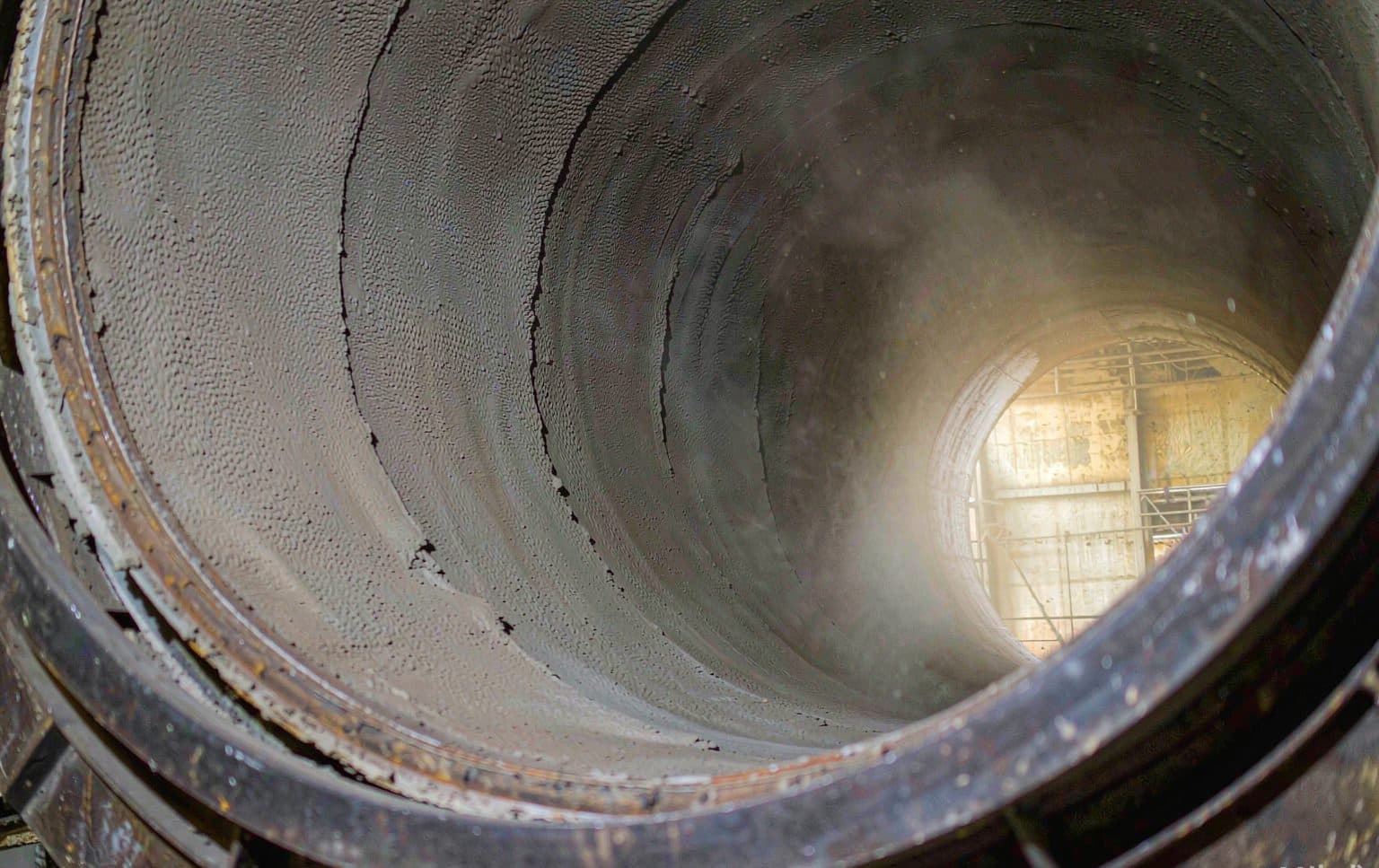
Key specifications
| Parameter | Value |
|---|---|
| Working layer | High-alumina castable, 230–300 mm |
| Working layer grade | Al₂O₃ 70–80%, service limit 1,600 °C |
| Hot-face alternative | Mullite castable where alkali attack is severe |
| Insulation layer | Lightweight castable or ceramic fibre board, 65–115 mm |
| Shell temperature target | ≤ 90 °C above ambient at steady state |
| Anchors | 310S stainless, V-pattern, 6 per m² |
| Expansion joints | Every 1.5 m, 8–10 mm, ceramic fibre filled |
| Cure schedule | 24 h ambient + 24 h at 120 °C + 12 h at 350 °C |
| Dry-out curve on site | 72 h to working temperature, controlled at 50 °C/h |
| Typical life, rotary kiln | 3–5 years, zone 3 shortest |
| Typical life, shaft furnace | 5–8 years |
| Relining duration | 10–15 days including dry-out |
Why three layers instead of one thick wall
Working layer — the part that wears
A dense high-alumina castable with 70–80% Al₂O₃ faces the charge and the steam. Its job is to resist abrasion from moving carbon and chemical attack from the alkali oxides in shell ash. This is the layer you replace; the rest of the lining usually survives.
Insulation layer — the part that saves fuel
Lightweight castable or ceramic fibre board cuts heat loss through the shell. Without it, a 1 t/h kiln loses 15–20% more fuel and the outer shell runs hot enough to distort and to endanger anyone who touches it.
Anchors and expansion joints — the part that fails first
Most lining failures start here, not in the hot face. Stainless V-anchors hold the castable to the shell; expansion joints every 1.5 m give the castable somewhere to grow. Omit either and you get a crack that opens in the first thermal cycle and spalls within a year.
How to tell your lining is going, before it fails
A lining almost never fails suddenly. It announces itself in four ways, and each one is measurable without shutting down.
First, shell temperature. Paint a stripe or fix thermocouples at three points along the kiln and record weekly. A rise of 30 °C above your commissioning baseline means the insulation has been compromised somewhere, even if the hot face looks intact through the inspection door.
Second, iodine value drift at constant settings. When zone 3 spalls, a cold patch forms; carbon passing it is under-activated and blends into the product. You see a 20–40 mg/g drop with no change in feed, steam or temperature setpoint. Operators usually chase this as a process problem for weeks before someone looks inside.
Third, fuel consumption creep. A 5–8% rise over a few months at constant tonnage is heat going through the shell instead of into the charge.
Fourth, refractory in the product. Any grit in the discharge screen is a lining that has already failed. Stop and inspect — continuing runs the risk of a shell hotspot and, in the worst case, a wrap.
Material selection by zone
| Zone | Temperature | Dominant wear | Recommended material |
|---|---|---|---|
| Feed and dry | 200–400 °C | Moisture, mild abrasion | Fireclay castable, 40–45% Al₂O₃ |
| Heat-up | 400–850 °C | Thermal cycling | High-alumina castable, 60–70% Al₂O₃ |
| Activation | 850–1,100 °C | Alkali attack, abrasion, steam | High-alumina 70–80% or mullite castable |
| Discharge and cooler | 800–100 °C | Thermal shock | Andalusite or low-cement castable |
| Shaft furnace reaction zone | 900–1,100 °C | Alkali, static load | High-alumina brick, 75–80% Al₂O₃ |
What a relining involves
- Cool-down on a controlled curve — 72 hours, not a water spray.
- Internal inspection and measurement of remaining thickness at 12 points per zone.
- Removal of failed material by hydraulic breaker; anchors inspected and replaced where corroded.
- Shell thickness measurement by ultrasonic gauge before new material goes in.
- Casting in lifts with vibration, expansion joints placed to drawing.
- Cure: 24 hours ambient, 24 hours at 120 °C, 12 hours at 350 °C.
- Dry-out on site: 72 hours to working temperature at no more than 50 °C per hour.
- First-week monitoring: shell temperature log and iodine value at every shift.
Why the lining is designed with the furnace
A lining bought as a consumable is designed to a drawing, not to a heat balance. When lining design sits inside the furnace design, three things get decided together: the insulation thickness that gives the fuel consumption we promised, the anchor pattern that survives the thermal cycling of your particular duty, and the zone lengths that let you replace only the activation section instead of the whole kiln. That is why we cast and cure linings in our own workshop and log the curve, rather than shipping loose material for site mixing.
Questions buyers ask before ordering
Straight answers with numbers. If yours is missing, send it over.
How often does an activation furnace lining need replacing?
Can I replace only part of the lining?
Can I buy the castable locally and install it myself?
How long does the furnace stay down for a reline?
Does lining quality really affect iodine value?
Send the raw material, target tonnage and finished spec. You get a configuration, a utility schedule and a budget range — not a brochure.