Activated carbon post-treatment — washing, de-ironing and sizing that earn the higher price
What leaves the kiln is a semi-finished product. Ash, iron content and particle size distribution decide which market it enters — that is what this section builds.
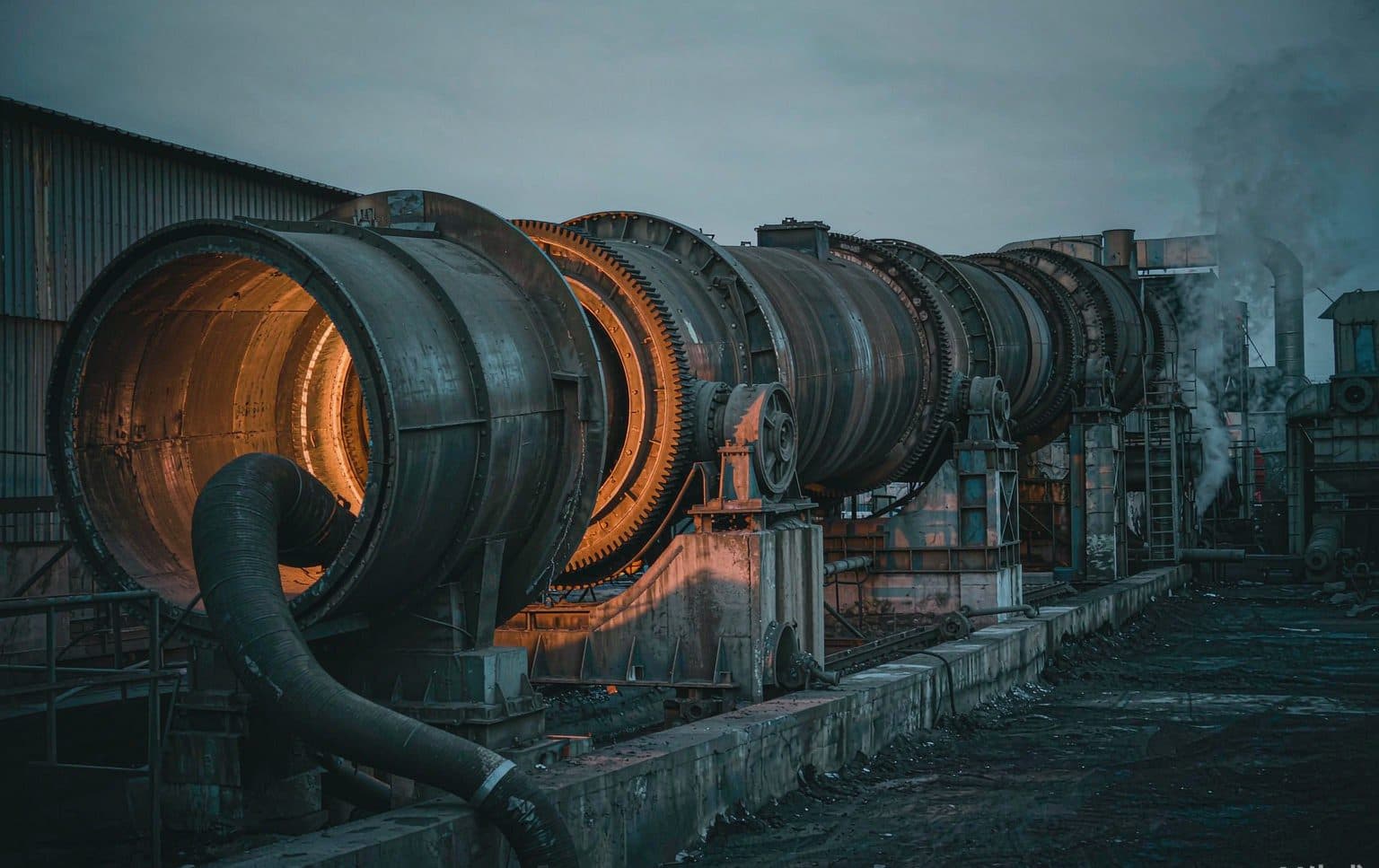
Key specifications
| Parameter | Value |
|---|---|
| Capacity | 1.0 t/h, matched to the main line (0.5–3 t/h available) |
| Feed | Activated discharge, 8–12% ash, fines ≤ 8% |
| Acid wash | Hydrochloric acid loop, 3–5% concentration, 60–80 °C, 60–120 min |
| Acid consumption | 40–80 kg of 31% industrial HCl per tonne |
| Water consumption | 3–6 m³/t, down to 2–3 with counter-current rinsing |
| Ash after treatment | 2–4%; below 1.5% achievable on coconut shell |
| Iron content | ≤ 300 ppm standard, ≤ 100 ppm food grade |
| Product pH | 6–8 after rinsing |
| Dewatering | Filter press, 45–55% moisture |
| Drying | Rotary dryer, 50% → 8% moisture |
| De-ironing | Permanent magnet plus electromagnetic, two stages, > 90% removal |
| Screening | 3–4 decks to order (8×30, 12×40, 20×50, 30×60) |
| Homogenising | 50–100 m³ blending silo, batch iodine spread ≤ ±20 mg/g |
| Wastewater | 3–6 m³/t, neutralisation, settling and reuse |
| Installed power | 60–90 kW |
| Lead time | 90–120 days including commissioning and laboratory handover |
Three numbers separate one kiln's output from two price tiers
Carbon leaving the kiln may already test at 1000 mg/g iodine, but it is not yet a saleable product. Buyers look at three things: ash, iron content and particle size distribution. Those three decide which market it enters.
Ash is the hardest gate. Carbon for industrial wastewater is acceptable at 8–12% ash; potable water and food decolourisation require below 3%, good producers reach 1.5%, and some European orders cap it at 1%. Moving the same carbon from 10% to 3% ash moves it up a price tier. How much that tier is worth depends on the specification, the order size and the market that month — we do not quote a fixed spread here.
Iron is the second. Iron in carbon is not an inert impurity: it leaches in water treatment and colours the effluent, and on food decolourisation lines it acts as a catalyst that oxidises and darkens pigments. The usual limit is ≤ 300 ppm, with ≤ 100 ppm for food grade. That number needs both acid washing and magnetic separation — magnets alone remove free iron but not iron locked inside the ash.
Particle size is the third and the most often overlooked. Screened to 8×30 or to 30×60, the same batch serves two entirely different markets: the coarser cut goes into water treatment beds where pressure drop and backwash matter, the finer cut into food decolourisation and catalyst support. Without adequate screening capacity, everything is sold blended — high-value product leaving at low-value prices.
The five stages cannot be reordered
| Stage | Purpose | Key parameters | If skipped |
|---|---|---|---|
| Acid wash | Dissolve metal oxides and carbonates in the ash | 3–5% HCl, 60–80 °C, 60–120 min | Ash stays high and everything downstream is wasted |
| Rinsing | Remove residual acid, restore pH | 3–5 counter-current stages, outlet pH 6–8 | Acidic product, failed incoming inspection |
| Dewatering | Reduce moisture from 50% to 45–55% | Filter press | Drying energy doubles, 30–50 m³ extra gas per tonne |
| Drying | Bring moisture below 8% | Rotary dryer, 50% feed, steam or hot gas | Blinded screens and caked bags |
| De-ironing and screening | Set the specification | Two magnetic stages, 3–4 decks | Unstable mesh and iron, whole batch rejected |
Acid washing is not universal — check the feed ash first
One rule decides it: if the finished product requires ≤ 3% ash and the feed runs above 6%, acid washing is necessary; if the feed is already below 3%, the gain is small and rinsing plus magnetic separation is enough.
By feedstock: coconut shell carbon naturally runs 1–3% ash and usually needs no acid wash except for premium export orders; apricot and peach shell char runs 3–6% and depends on the target grade; coal-based carbon runs 8–15%, where acid washing is mandatory and without it the product never reaches potable water markets.
There is a cost: 1–3% of the carbon is lost, partly structure carried out with the dissolved ash, partly fines lost in rinsing and filter pressing. That loss belongs in the yield calculation, not just the acid purchase price.
Before and after acid washing, with direct cost
| Item | Before | After |
|---|---|---|
| Ash | 8–12% | 2–4% |
| Iron content | 800–1500 ppm | ≤ 300 ppm |
| pH | 9–11 (alkaline ash) | 6–8 |
| Iodine value | Baseline | Essentially unchanged (±20 mg/g) |
| Carbon loss | — | 1–3% |
| Direct cost per tonne | — | 300–600 RMB (acid, water, power, wastewater) |
Wastewater is the real threshold on this line
Every tonne of carbon produces 3–6 m³ of acidic wastewater carrying residual acid, dissolved metal ions and fine carbon. This is not a baghouse problem that a filter solves: it needs neutralisation, settling, filter pressing and reuse, and it is routinely missed at the EIA stage — the plant layout simply has no room for the tanks when acceptance testing arrives.
The standard route is neutralisation with lime or caustic to pH 7–9, flocculation and settling, with the supernatant returned to the rinsing stage. Recovery reaches 70–85%, the remainder going to the site wastewater plant. Tank volume must be sized on eight hours of discharge, not one hour, otherwise a batch stops halfway through washing.
Where a plant has no wastewater treatment capability, rinsing alone is the better choice — rinse water is near neutral and an order of magnitude easier to handle. Projects that insisted on acid washing to hit an ash number and then failed wastewater acceptance are not rare.
Scope of supply
- Acid wash reactor or wash tank with circulation pump, heating and concentration control.
- Counter-current rinsing system: 3–5 stages with in-line pH monitoring.
- Filter press and filtrate recovery piping.
- Rotary dryer, fired by steam, natural gas or recovered kiln off-gas.
- Two-stage de-ironing: permanent magnet plus electromagnetic, with iron collection.
- 3–4 deck vibrating screens configured to the ordered mesh; 50–100 m³ homogenising silo.
- Wastewater neutralisation, settling and reuse unit, configured to local discharge rules.
- Laboratory handover: sampling and test procedures for ash, iron, pH and particle size distribution.
When you do not need this section
If you sell industrial carbon, your feed is already at or below 3% ash and buyers do not test iron, screening plus one magnetic stage is enough. Adding acid washing anyway wastes money: the acid section with its wastewater treatment typically costs three to five times more than screening and de-ironing, and only pays back when the product moves up to potable grade, food grade or export. Decide who buys the carbon before deciding whether to build this.
Questions buyers ask before ordering
Straight answers with numbers. If yours is missing, send it over.
What is the difference between acid washing and plain rinsing?
How much of the line investment is post-treatment?
Can the wastewater be eliminated?
How is the mesh decided, and what separates 8×30 from 12×40?
Send the raw material, target tonnage and finished spec. You get a configuration, a utility schedule and a budget range — not a brochure.