Spent carbon reactivation kiln — 0.5 to 2 t/h, putting used carbon back to work
Three controlled zones: desorption, pyrolysis, gasification. 5–10% burn-off per pass, 85–95% of the original iodine value recovered, typically three to six cycles on the same carbon.
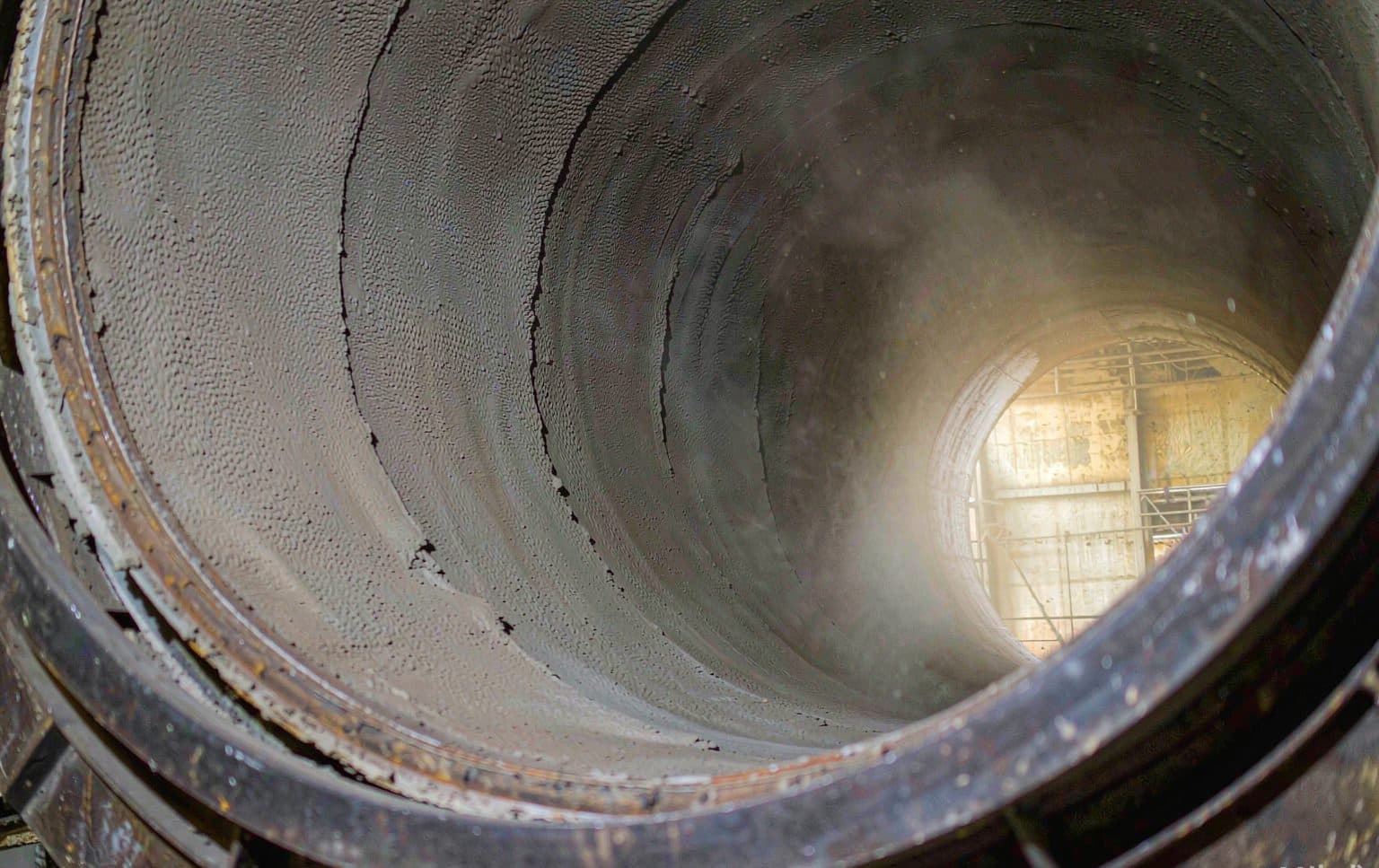
Key specifications
| Parameter | Value |
|---|---|
| Reactivation capacity | 1.0 t/h · 24 t/day (≈7,200 t/year at 300 days) |
| Feed requirements | Granular 0.5–4 mm, moisture ≤ 10%, fines ≤ 10% |
| Kiln shell | Φ1.6 × 12 m, heat-resistant steel inner shell with refractory lining |
| Rotation | 0.8–2.5 r/min, VFD |
| Residence time | 45–90 minutes, set by rotation and slope |
| Zone 1 · drying and desorption | 100–150 °C |
| Zone 2 · pyrolysis | 300–500 °C, oxygen excluded |
| Zone 3 · gasification | 700–900 °C, steam 0.3–0.8 kg/kg carbon |
| Burn-off | 5–10% per pass, depending on load and target recovery |
| Iodine recovery | 85–95% of virgin value (first three passes) |
| Afterburner | 1,100 °C, ≥ 2 s residence |
| Off-gas train | Waste-heat boiler + quench + caustic scrubber + bag filter |
| Fuel | 60–100 m³ natural gas per tonne reactivated (including afterburner) |
| Power | 40–60 kWh per tonne |
| Installed power | 75 kW |
| Discharge temperature | ≤ 80 °C after the water-jacket cooling section |
| Control | PLC with three-zone thermocouples and O₂ interlocks |
| Design life | Lining 3–5 years, shell 10+ years |
Reactivation clears pores; activation creates them
Virgin activation is a pore-building process: at 850–1,100 °C steam reacts with carbon to form CO and H₂, and every kilogram of carbon consumed opens new micropores. Reactivation is the opposite problem. The pores are already there, filled with adsorbate. The job is to desorb, crack and gasify that material so the existing structure is exposed again.
Two operating numbers follow directly. Steam demand drops from 1.2–2.2 kg/kg of carbon during activation to 0.3–0.8 kg/kg during reactivation, and residence time falls from tens of minutes to hours down to 45–90 minutes. Run reactivation on activation settings and burn-off climbs from 6% to beyond 15%: pore walls thin out, hardness drops, and iodine value ends up lower than it started. That single mistake explains most reports of reactivation not working.
The temperature sequence matters as much. Hit adsorbed organics with 800 °C from cold and they carbonise and coke across the pore mouths, sealing them. The slow three-zone ramp is part of the process, not a warm-up.
What each zone is doing
| Zone | Temperature | Residence | Purpose | What goes wrong |
|---|---|---|---|---|
| 1 · drying and desorption | 100–150 °C | 10–20 min | Evaporate water, strip low boilers | Ramp too fast: wet carbon balls up and sticks to the shell |
| 2 · pyrolysis | 300–500 °C | 20–35 min | Crack heavy organics into light gases and char | Insufficient oxygen exclusion: local combustion, doubled burn-off |
| 3 · gasification | 700–900 °C | 15–35 min | Steam-gasify residual char and tar | Above 950 °C: pore walls burn through, iodine value falls |
| Cooling | ≤ 80 °C | before discharge | Prevent self-ignition on the conveyor | Above 120 °C the carbon oxidises on the belt |
Burn-off and recovery move in opposite directions
Read the two numbers together or neither will make sense. Below 4% burn-off the organics were probably not fully removed and recovery stalls under 80%; above 12% the pore walls are already damaged and recovery drops again. Five to ten percent is the useful window, and where you sit inside it depends on what the carbon adsorbed.
In practice: coconut and coal-based granular carbon from drinking-water or wastewater duty reaches 90–95% recovery at 6–8% burn-off. Decolourising carbon from sugar or oil duty carries large molecules and recovers only 80–88% at the same burn-off, and needs de-oiling first or the tar will ring the kiln.
The cumulative effect belongs in the cost model. At 6–8% per pass, three passes cost roughly 20% of the carbon mass; after the fourth pass iodine value generally sits below 80% of virgin, which is the point to downgrade the carbon to a less demanding duty rather than reactivate it again.
What can be reactivated, and what should not enter the kiln
| Feed | Verdict | Why, and what to do |
|---|---|---|
| Granular carbon from water treatment (coconut, coal) | Suitable | Standard reactivation, best recovery of any category |
| Decolourising carbon (sugar, oil) | Suitable with pre-treatment | De-oil first or tar rings the kiln; 80–88% recovery |
| Silver-, iodine- or sulphur-impregnated carbon | Not suitable | Metals and halogens report to the off-gas; needs metal recovery, not thermal reactivation |
| Carbon carrying mercury or lead | Not suitable | Hazardous waste; requires a licensed disposal route |
| Powdered carbon (< 0.5 mm) | Not in a rotary kiln | Entrainment and dust; use multiple hearth or indirect heating |
| Carbon above 15% moisture | Dewater first | Otherwise zone 1 becomes a boiler: doubled fuel and sticking |
Solid-waste carbons: ash decides whether it is worth reactivating
"Solid waste reactivation furnace" is a common line item in tender documents, but it is not a furnace type — it covers three quite different feeds. Two numbers decide whether a rotary kiln can take the material: ash content, and iodine value as received. Ash sets whether the reactivated carbon has any value left; iodine sets how much can be recovered.
Above 20% ash, two problems follow. The first is ringing: ash accumulates and bakes onto the lining, heat transfer drops, material flow stalls, and cleaning means one to two days of downtime. The second is ash handling: at 1 t/h and 30% ash, 300 kg of ash leaves the kiln every hour, and the discharge, conveying and storage equipment has to be sized for it. Plenty of proposals leave this out and the plant blocks up within weeks.
So the first question in a solid-waste project is not tonnage, it is the ash analysis. If the lab sheet has no ash and no iodine number, do not quote a model yet.
Four solid-waste feeds and how they behave
| Feed | Ash | Iodine as received | Verdict |
|---|---|---|---|
| Spent granular carbon from water and wastewater plants | 8–15% | 500–700 | Suitable — the main feed, 85–92% recovery |
| Industrial wastewater carbon (coking, dyeing, pharma) | 10–20% | 400–650 | Suitable, but high salt: wash before the kiln |
| Sludge pyrolysis char, sludge-based activated carbon | 30–50% | 300–500 | Not advisable — heavy ringing and little reuse value |
| Carbon injected into municipal waste incinerator flue gas | Dioxins and heavy metals | — | Not for thermal reactivation; treat as hazardous waste |
Hazardous-waste carbon: the answer depends on who you are
Spent activated carbon is regulated as HW49 in China. But whether you can build a reactivation unit depends on your position, not on which equipment you buy — the single most confused point in enquiries.
A generator that reactivates only its own carbon, with no third-party intake, is building a pollution-control facility under its EIA permit; no hazardous waste operating licence is required. The moment you accept someone else's carbon and charge for it, the activity becomes hazardous waste treatment: a licence is mandatory, and cross-province movement needs approval and manifests. That is a business-model decision made at project approval, not an equipment question.
Local practice varies, sometimes between cities in the same province. Take the process scheme to the local environmental authority before the project is approved: it costs nothing, whereas retrofitting permits after commissioning usually means a shutdown and rectification. We provide process flow diagrams, mass balance and off-gas design data for the EIA, but we do not obtain permits or lend our name to an application.
Three positions, three routes
| Your position | Can you build | Key constraint |
|---|---|---|
| Generator handling only its own carbon | Yes | EIA as a pollution-control facility; full manifests; no third-party intake |
| Reactivating for third parties commercially | Licence required | Hazardous waste operating licence; cross-province approval; manifests |
| Buying equipment only | Yes | We supply equipment and process know-how, not the disposal licence |
Rotary reactivation versus multiple hearth
| Item | Rotary reactivation kiln | Multiple hearth |
|---|---|---|
| Capacity per line | 0.5–2 t/h | 2–10 t/h |
| Residence time | 45–90 min | 2–4 h |
| Temperature uniformity | Moderate, axial gradient | Better, independently fired hearths |
| Burn-off | 6–10% | 5–8% |
| Iodine recovery | 85–95% | 88–96% |
| Capital cost at equal tonnage | 1.00 | 1.50–1.80 |
| Maintenance | Low: lining and seals | High: rabble arms, hearths, drive |
| Where it fits | Mid-size, mixed feed, campaign operation | Large, single feed, continuous operation |
Scope of supply
- Three-zone rotary kiln with heat-resistant inner shell, refractory lining and cooling section.
- Feed system: silo, screw feeder and double flap valve for air exclusion.
- Steam system: evaporator, superheater, flow and pressure control.
- Afterburner, waste-heat boiler, quench tower, caustic scrubber and bag filter.
- Water-jacketed discharge section with enclosed conveying.
- PLC cabinet: three-zone temperature, O₂ interlocks, off-gas temperature and differential pressure logging.
- Start-up curve, sampling protocol (iodine value, methylene blue, burn-off) and a two-year spare parts list.
Two constraints that get underestimated: permits and off-gas
First, permits. Spent activated carbon is regulated as hazardous waste in China (HW49) and in many other jurisdictions; collection, transport and treatment require a licence, and cross-province movement needs approval. We supply equipment and process know-how, not a disposal licence — if your business model is reactivating for third parties, settle the permit route before you buy a kiln. Second, off-gas. The afterburner must hold 1,100 °C for two seconds, followed by rapid quenching to avoid the 200–500 °C window where dioxins re-form, then scrubbing and filtration. That train frequently costs as much as the kiln itself; budgeting only for the kiln badly understates the project.
How far this line goes here
Reactivation is rotary-only here, 0.5–2 t/h per line, and we do not build multiple-hearth furnaces. Above 2 t/h, or where batch iodine spread must stay within ±20 mg/g, a multiple hearth is the better machine — we will say so at the first call rather than push a kiln that cannot hit the number. The reactivation kiln shares its shell, lining and drive logic with our activation kilns; what differs is the temperature zoning, steam flow and off-gas configuration.
Questions buyers ask before ordering
Straight answers with numbers. If yours is missing, send it over.
How many times can the same carbon be reactivated?
What iodine recovery should I expect?
Can one kiln do both activation and reactivation?
How much energy does reactivation take per tonne?
What permits are needed?
Are a solid-waste reactivation furnace and a hazardous-waste one different machines?
Send the raw material, target tonnage and finished spec. You get a configuration, a utility schedule and a budget range — not a brochure.