Shaft furnace (SLEP) lining — high-alumina brickwork and a 15–20 day reline
The bed does not turn and the brick does not abrade, yet thermal cycling and alkali in the shell ash still work their way into the joints. Shaft lining design is a different discipline from rotary kiln lining.
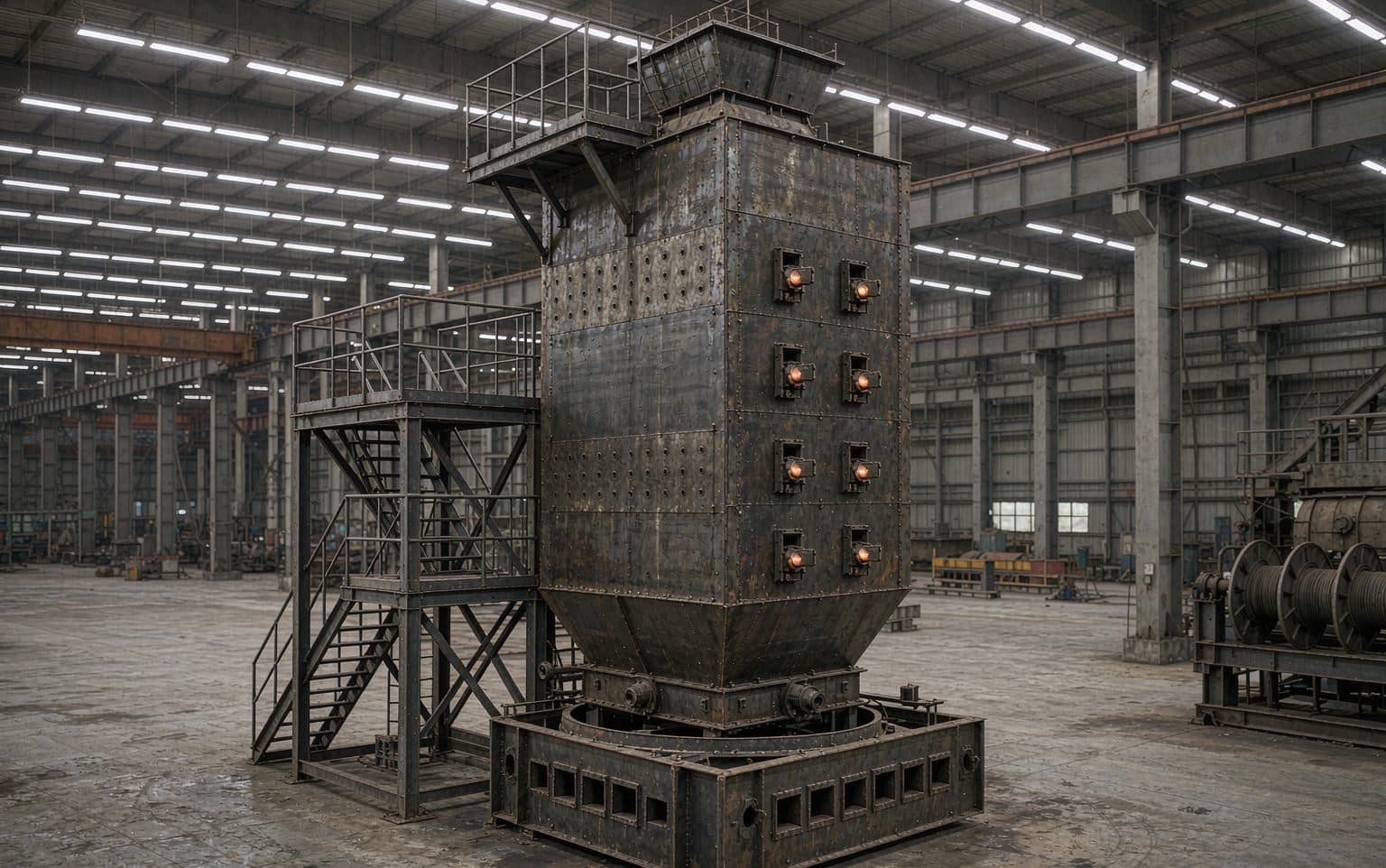
Key specifications
| Parameter | Value |
|---|---|
| Working layer | High-alumina brick, 230–300 mm, Al₂O₃ 65–80% |
| Preheat zone brick | Clay brick / low-porosity clay brick |
| Cooling zone brick | Abrasion-resistant high-alumina brick, thermal-shock resistant |
| Joints | 2–3 mm, high-alumina mortar matched to the brick |
| Expansion joints | 8–10 mm every 3–4 m, ceramic fibre filled |
| Backing | Castable levelling layer, 30–50 mm |
| Insulation | Lightweight castable or ceramic fibre board, 65–115 mm |
| Tie-backs | Stainless steel, one per 1.5 m² |
| Lining life | 5–8 years; activation zone is the shortest |
| Reline duration | 15–20 days including dry-out |
| Dry-out | 3–4 days, max 50 °C per hour |
Why a shaft furnace is brick-lined and a rotary kiln is cast
Brickwork can be replaced zone by zone
The lining is laid brick by brick, so a damaged zone can be replaced on its own — the preheat zone may still have five years of life left while the activation zone is due. A castable lining works as one structural body: once a crack opens, heat and alkali vapour follow it and the whole section has to come out.
A static bed needs compressive strength and alkali resistance, not impact resistance
Material descends slowly under gravity, so the face sees almost no impact abrasion. The real enemies are alkali vapour migrating into the brick and repeated thermal expansion and contraction. High-alumina brick holds its porosity and refractoriness-under-load more consistently than castable of the same grade, and the joints absorb expansion so the lining as a whole stays tight.
The joint is the breathing gap and the weak point
A 2–3 mm joint gives each brick room to grow, spreading expansion across hundreds of joints. That same joint is the path for alkali vapour. Open the joint, or use a lower-grade mortar, and alkali reaches the backing — the first sign is a hot patch on the shell. Eight tenths of shaft lining performance is decided at the trowel.
Three zones, three brick types
A SLEP furnace is divided by process into three zones: preheat (ambient to about 900 °C), activation (880–960 °C with superheated steam in counter-current flow) and cooling (900 °C down to below 150 °C). The thermal duty differs enough that one brick cannot serve all three.
The preheat zone runs cooler but takes long-term abrasion and alkali from the shell ash; clay or low-porosity clay brick is sufficient, and this zone usually outlasts the activation zone by half again. The activation zone is the core: highest temperature, highest alkali concentration, steam present. It needs 65–80% Al₂O₃ brick at 230–300 mm. The cooling zone looks mild but is the hardest on thermal shock — the discharge area cycles hot and cold constantly, so specify a thermal-shock-resistant abrasive brick rather than reusing the activation brick.
For a 1 t/h furnace the shell is about 11.5 m tall, split roughly 3 m preheat, 5 m activation and 3.5 m cooling. That ratio drives both the brick mix and the maintenance calendar: the activation zone occupies the largest share and sets the reline interval for the whole furnace.
Brick selection by zone
| Zone | Temperature | Dominant wear | Brick | Thickness | Typical life |
|---|---|---|---|---|---|
| Preheat | 400–900 °C | Alkali, abrasion | Clay / low-porosity clay brick | 230 mm | 6–8 years |
| Activation | 880–960 °C | Alkali, steam oxidation, thermal cycling | High-alumina brick 65–80% Al₂O₃ | 230–300 mm | 5–7 years |
| Cooling | 900 → 150 °C | Thermal shock, discharge abrasion | Abrasion-resistant high-alumina brick | 230 mm | 5–6 years |
| Roof and feed opening | 300–600 °C | Mechanical impact, thermal shock | High-alumina castable | 150–200 mm | 4–6 years |
Seven rules of the brickwork
- Keep joints at 2–3 mm with mortar matched to the brick; above 4 mm, alkali vapour has a straight channel.
- Break joints — never allow a continuous vertical joint; stagger at least one third of a brick length.
- One 8–10 mm expansion joint every 3–4 m, ceramic fibre filled, no brick chips left inside.
- Lay out the brick mix to the shell and close with taper brick; cut brick loses its dense skin and must not go on the working face.
- Weld tie-backs to the shell at one per 1.5 m² to stop the lining shifting as a body.
- Check plumb and inside diameter every metre; more than 5 mm of deviation means rework, because errors stack as the lining rises.
- Air-dry 24 hours, then dry out over 3–4 days at no more than 50 °C per hour.
Four signs the lining is going
First, shell temperature. Measure four to five points up the shell and log weekly. Thirty degrees above the commissioning baseline means joints are leaking, even if the face still looks intact through the inspection port. Hot patches usually appear in the lower half of the activation zone first, where alkali concentration is highest.
Second, joints that glow or leak. On shutdown, blackened joints and powdery mortar mean alkali has reached the backing and that zone should be scheduled for replacement.
Third, refractory grit in the discharge. Any sand on the screen means the working face has spalled; keep running and you wear the discharge equipment and carry ash into the product.
Fourth, iodine number down 20–40 mg/g with no process change. Local spalling creates a cold band where char is under-activated, and that fraction drags the average down — the failure most often chased for weeks as a process problem.
The 15–20 day reline
| Step | Duration | Key point |
|---|---|---|
| Shutdown and cooling | 2–3 days | 50 °C per hour; never quench with water |
| Brick removal and shell cleaning | 3 days | Top down; clean the shell to bare metal |
| Inspection and thickness survey | 1 day | Ultrasonic shell thickness; check every tie-back |
| Brickwork | 5–7 days | Broken joints, expansion joints and brick mix per drawing |
| Air drying | 1 day | Ventilate; no open flame |
| Dry-out | 3–4 days | Max 50 °C per hour, hold 12 hours at working temperature |
When a partial reline is acceptable
Partial replacement makes sense only when three conditions hold together: residual thickness above 60% in the preheat and cooling zones, shell heating confined to the activation zone, and no change in furnace plumb. It cuts the job to 8–10 days and about 40% of the cost — but the interface must be built as new brickwork, with its own expansion joint and staggered bond. Pressing fresh brick onto an old face cracks at the interface on the first heat-up.
Questions buyers ask before ordering
Straight answers with numbers. If yours is missing, send it over.
Can a SLEP furnace be cast monolithically instead of brick-lined?
How often does a shaft furnace lining need replacing?
Is a partial reline of the activation zone possible?
Why does a shaft reline take longer than a rotary one?
How do I choose the alumina grade?
Send the raw material, target tonnage and finished spec. You get a configuration, a utility schedule and a budget range — not a brochure.